What you actually get#
Wheelhouse is an operating system image, not an application you install onto something else. This page says what is in it, what came from where, and what changes when you upgrade.
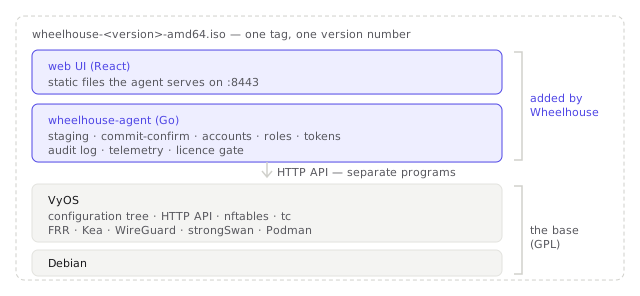
The three parts#
The image. wheelhouse-<version>-amd64.iso, about 595 MB, built from vyos-build
with a Wheelhouse image flavour. It boots as a live system, runs a dialog installer on
the first console, and installs onto a disk using VyOS' own install image. Both UEFI
and legacy BIOS boot are built in.
The agent. wheelhouse-agent, one static Go binary at /usr/bin/wheelhouse-agent,
run by a systemd unit as root. It is the control plane: it drives VyOS' HTTP API for
everything the configuration tree can express, holds the staging area, authenticates
people, keeps the audit log, parses operational state, and serves the API and the UI on
0.0.0.0:8443 over TLS.
The web UI. A React single-page application, built to static files at
/usr/share/wheelhouse/ui and served by the agent. It has no server of its own and no
build step at runtime; it is the same API you get, consumed by a browser.
One version number#
The agent, the UI, the installer, the packaging and the image are built and released together from one tag, and share a version. The console banner prints both halves above every login:
Wheelhouse <version> on VyOS <version>That means an upgrade is one artefact, and it also means the version you quote in a
support conversation is unambiguous. CHANGELOG.md is the record,
and each release's files are at https://releases.rhymelikedi.me/v<version>/.
Where the base ends and Wheelhouse begins#
Wheelhouse is built on VyOS, which is built on Debian. This is the line, and it is worth being precise about, because it tells you where a fix comes from.
| Provided by the base | Added by Wheelhouse |
|---|---|
The Linux kernel and its networking: nftables, tc, in-kernel WireGuard, namespaces, VLANs, bridges, bonds | The agent: staging, commit-confirm, revision rollback, accounts, roles, tokens, the audit log, the telemetry stream, the licence gate |
The configuration tree itself: set, commit, commit-confirm, revisions, rollback | The web UI: the pages, the editors that render commands, the Commit Bar, the ⌘K palette |
The daemons: FRR, Kea, pdns-recursor, strongSwan, OpenVPN, Suricata, Podman | The installer and the unattended seed path |
| The HTTP API the agent drives | The app catalogue and the integration hints |
| The Debian package base and its drivers | The image flavour, the packaging and the release pipeline |
The agent and the UI are separate programs from every GPL component. The agent talks
to VyOS over its documented HTTP API and over operational-mode commands. It links against
no VyOS code and copies none — no file in the repository is derived from vyos-1x, FRR,
Kea, pdns-recursor, nftables or the kernel
(docs/licenses.md).
Every image carries SOURCES-<version>.txt: the vyos-build commit it was built from
and every package version in it. It is beside the image on the download host and on the
installed system under /usr/share/doc/wheelhouse/, so a customer holding only the box
can still get from it back to the source. The VyOS trademark is not ours; images are
self-built and rebranded per upstream's trademark policy, attribution intact.
What survives an upgrade#
/config is VyOS' persistent partition, and it is where Wheelhouse keeps everything of
yours:
| Path | Holds |
|---|---|
/config/wheelhouse/state.json | accounts, password hashes, TOTP secrets, API token hashes, sessions, the audit log, settings and the licence key. Mode 0600. |
/config/wheelhouse/api-key | the VyOS API key the agent authenticates to the router with |
/config/wheelhouse/agent.crt, agent.key | the TLS certificate and its private key |
/config/config.boot and /config/archive/ | the running configuration and its archived revisions |
/config/apps/… | container volumes for apps you installed, deliberately left behind on uninstall |
VyOS keeps the previous image beside the new one after an upgrade, so the old system is still bootable. That is the platform's mechanism, not something Wheelhouse adds.
What it does not include#
- No arm64 image. amd64 UEFI or BIOS only. An arm64
.debis published, but it is for running the agent off-router against an arm64 VyOS box — it will not give you a Wheelhouse router. - No VM image. No qcow2, raw, OVA or VHD. A VM install is the same install as a physical one: attach the ISO and answer the questions.
- No wireless. VyOS can configure
interfaces wirelessfrom the CLI; the UI has no page for it and the installer does not offer it. Put an access point behind the router. - No SSH, until you ask for it. Neither the image's default configuration nor the
installer writes
service ssh. A freshly installed router has no SSH at all and the console is the only shell.
Running the agent without the image#
There is a second, supported shape: the agent runs on another machine and points at an
existing VyOS router's HTTP API. That is how the product is developed, and it is how you
can look at Wheelhouse against a router you already have without reinstalling anything.
Everything that reads works; the parts that need the router's own filesystem — creating
an app's volume directories, for one — say so rather than pretending
(docs/deploy.md).
wheelhouse-agent --demo starts with no router credentials at all, which is enough to
click through the interface and to reproduce most API behaviour in a bug report.